When Understanding Becomes Emotional Bypassing
For years, I believed I had done my healing work.
I had explored the wounds of my childhood. I had worked with trauma, practiced meditation, studied spiritual teachings, and learned the profound importance of forgiveness.
I had forgiven my mother.
I had forgiven my father.
I had worked to forgive myself.
And I believed I had made peace with my past.
But recently, something unexpected happened.
While writing my Soul Paper for my Masters of Wisdom Meditation Teacher Training, I began revisiting the story of my life.
And I began to cry.
Not just a few tears of recognition, but deep waves of grief.
I found myself mourning a childhood I had never truly allowed myself to mourn.
And a realization came to me:
I had forgiven, but I had not fully grieved.
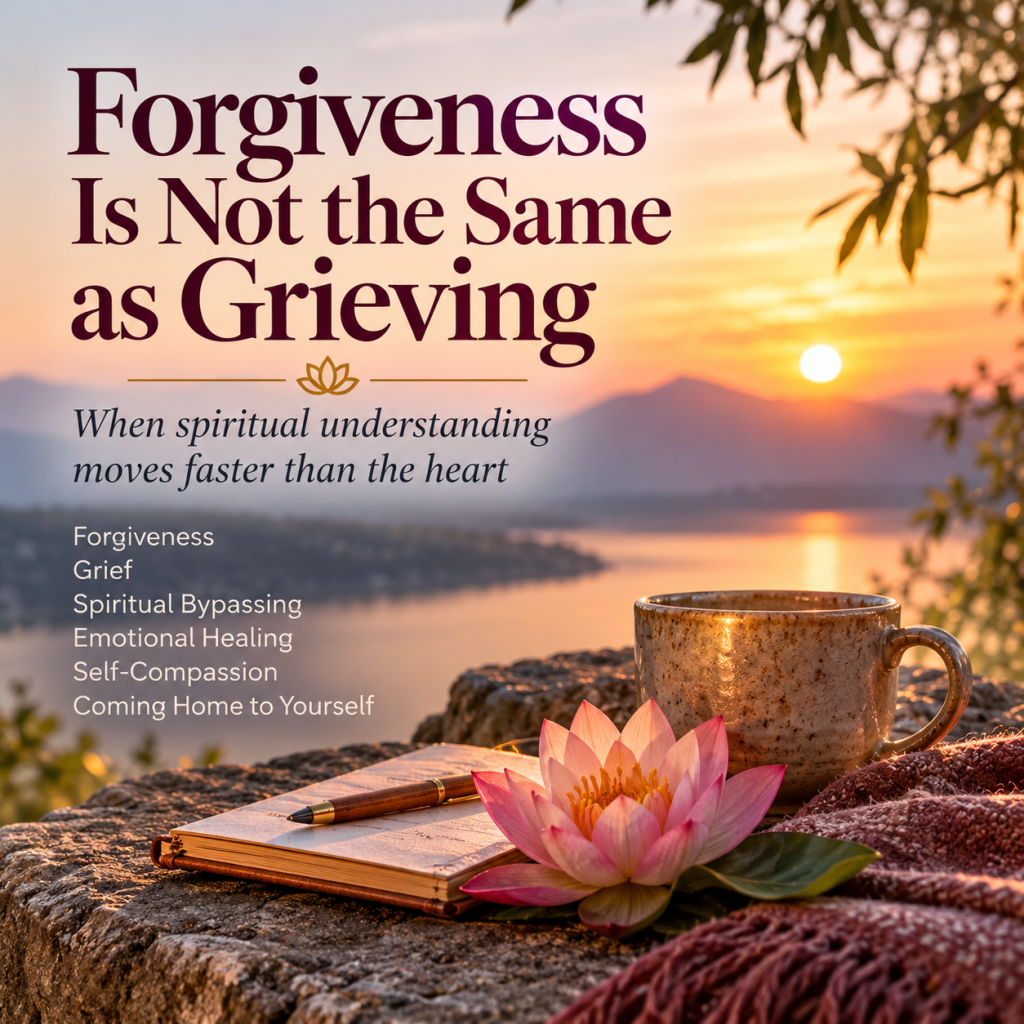
Forgiveness and Grief Are Not the Same
Forgiveness is often described as releasing resentment, anger, and the emotional burden of what has happened to us.
It can be a profound act of liberation.
But forgiveness does not automatically resolve grief.
Grief asks something different of us.
Grief asks us to acknowledge what was lost.
The childhood we never had.
The love we needed but did not receive.
The safety we deserved.
The relationships that never became what we hoped they would be.
The years spent surviving instead of fully living.
We can forgive someone and still grieve what happened.
We can understand another person’s limitations and still feel the pain of what their actions cost us.
We can release resentment without pretending that nothing was lost.
Forgiveness says, “I am no longer willing to carry this resentment in the same way.”
Grief says, “Something precious was lost, and I need to honor that loss.”
Both deserve a place in our healing.
When Understanding Becomes Emotional Bypassing
Sometimes we become so good at understanding our experiences that we lose touch with feeling them.
We can explain why someone behaved as they did.
We can recognize the wounds they carried.
We can forgive them.
We can even feel genuine compassion for them.
And yet, somewhere beneath all that understanding, there may still be sadness, anger, disappointment, or grief that has never been fully acknowledged.
This is one way emotional bypassing can occur.
Rather than allowing ourselves to experience uncomfortable emotions, we move toward explanations, acceptance, positive thinking, or spiritual wisdom.
Not necessarily because we’re being dishonest with ourselves.
Sometimes these approaches helped us survive. Sometimes they brought genuine relief.
But understanding an experience is not always the same as emotionally processing it.
And forgiveness does not eliminate the need to grieve.
We can understand why something happened and still mourn what it cost us.
When Spirituality Becomes a Way of Avoiding Pain
There is a related term for something many of us experience on the spiritual path: spiritual bypassing.
It happens when we use spiritual ideas, practices, or beliefs to avoid facing painful emotions or unresolved experiences.
We tell ourselves:
Everything happens for a reason.
I have forgiven.
I have surrendered.
I choose love over fear.
I am grateful for everything that brought me here.
These statements may reflect genuine spiritual insight.
But sometimes they can also become ways of moving past our feelings before we have fully experienced them.
We may understand our suffering intellectually without allowing ourselves to feel its emotional weight.
We may mistake acceptance for the absence of sadness.
We may believe that if we are truly spiritual, we should no longer feel anger, grief, regret, or disappointment.
But being spiritually awake does not mean being emotionally untouched.
We do not have to rise above our humanity to become whole. We have to make room for it.
The Grief Beneath the Forgiveness
As I continued writing my Soul Paper, memories surfaced.
Some were painful. Some were tender. Others reminded me of how much of my early life had been devoted simply to surviving.
And I realized that although I had spent years understanding my childhood, I had not fully mourned it.
I had learned to forgive the people who hurt me.
But I had not always extended that same compassion to the little girl who had been hurt.
Nor had I fully extended compassion to the woman I became during the most difficult years of my adult life.
I could speak about self-love and forgiveness.
Yet sometimes, when memories arose of things I regretted saying or doing, I still felt myself recoil.
There was understanding.
There was accountability.
But there was also shame.
And perhaps something even deeper: a lingering difficulty in accepting the woman I once was.
I am discovering that self-compassion does not mean excusing our mistakes.
It means recognizing that we can take responsibility without condemning ourselves forever.
Grieving Is Not Going Backward
One of the most important things I am learning is that grief is not evidence that our previous healing was incomplete or meaningless.
Healing is rarely a straight line.
We can experience genuine transformation and later discover another layer of sadness that needs our attention.
We can feel grateful for the present and still mourn the past.
We can forgive and still cry.
We can be peaceful and still have painful memories.
We can love our lives today while acknowledging that parts of our lives were profoundly difficult.
And sometimes, the tears arrive only when we finally feel safe enough to let them come.
I am not trying to force my grief into a lesson or hurry it toward a conclusion.
I am learning to allow it.
To listen.
To soften.
To offer myself the compassion I so freely encourage others to offer themselves.
Coming Home to Ourselves
Perhaps healing is not about reaching a point where nothing hurts anymore.
Perhaps it is about changing our relationship with the parts of ourselves that have been hurting.
Instead of turning away, we learn to stay.
Instead of judging, we become curious.
Instead of demanding that we be finished with our pain, we allow ourselves to be human.
I began writing my Soul Paper believing I was telling the story of a healing journey I had already traveled.
What I did not expect was that the writing itself would become another step in that journey.
And perhaps that is the invitation for all of us.
Not to forgive before we are ready.
Not to grieve on anyone else’s timetable.
Not to use spirituality to escape our humanity.
But to discover that our spiritual practice can become a safe and compassionate place in which to experience it.
With love,
Sandi Greene

Leave a Reply