There comes a time when adding more is no longer the answer.
More information. More striving. More rules. More ways to improve ourselves.
Sometimes the invitation is exactly the opposite.
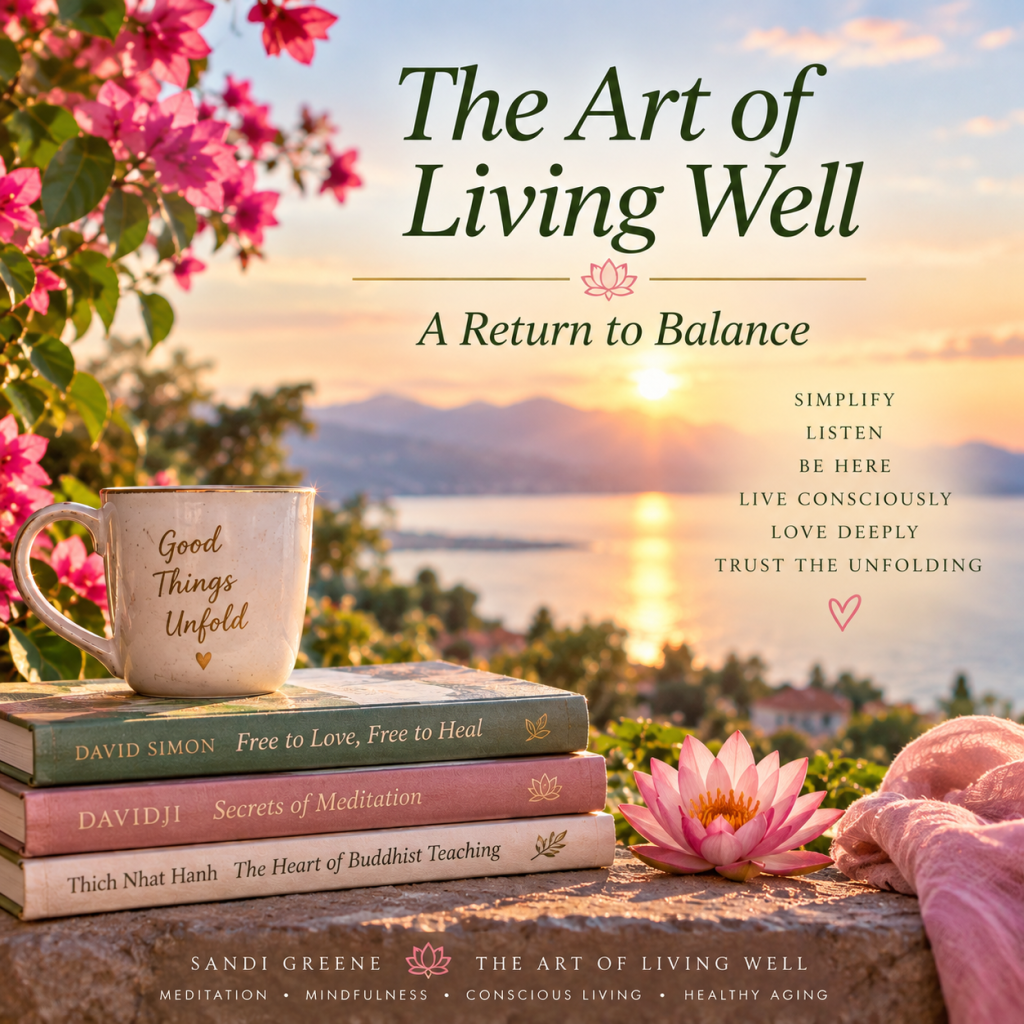
Simplify. Listen. Return to balance.
I find myself standing in that place now.
I am midway through my meditation teacher training with Davidji, and these past months have immersed me in an extraordinary landscape of ancient wisdom and contemporary teaching. I have been reading the Bhagavad Gita, the Yoga Sutras, Buddhist teachings, The Four Agreements, Ram Dass, Pema Chödrön, Thich Nhat Hanh, Nonviolent Communication, and Davidji’s teachings on meditation, stress, and the sacred powers available to us in everyday life.
Each has opened a different door.
But the work I keep returning to is that of the late Dr. David Simon.
Where East Meets West
Dr. Simon was a physician and neurologist who brought together the worlds of Western medicine and Eastern wisdom. His teachings embrace meditation, Ayurveda, yoga philosophy, emotional healing, the body, the mind, and the spirit—not as separate pieces of a life, but as parts of one whole human being.
That wholeness speaks deeply to me.
In books such as Free to Love, Free to Heal and The Ten Commitments, I find something I have been seeking for a long time: wisdom without rigidity.
Not another collection of rules about how we are supposed to live.
An invitation to listen.
To notice.
To become more conscious.
And to come back into balance.
The Wisdom of Enough
One of the yogic principles that has become increasingly meaningful to me is aparigraha, often translated as non-grasping or non-attachment.
I am beginning to understand it less as something to practice and more as a way of moving through life.
Do what is mine to do.
Show up wholeheartedly.
Teach what I love.
Love the people in front of me.
Care for this body.
Nourish my mind.
Tend to my spirit.
And then—release my grip on what happens next.
The Bhagavad Gita offers essentially this same wisdom: we are responsible for our actions, but we cannot control the fruits of those actions.
What freedom there is in that.
I can show up authentically and wholeheartedly without chasing an outcome.
I can plant the seed without digging it up every morning to see whether it has grown.
I can participate fully in my life while still allowing life to unfold.
Balance Is Not Perfection
Perhaps this is what I am learning most deeply right now:
Balance is not perfection.
It isn’t a perfectly executed morning routine, a perfect diet, a perfectly quiet mind, or a life in which nothing difficult happens.
Balance is relationship.
It is listening to the body when it asks for rest. Nourishing ourselves when we are depleted. Moving when we have been still too long. Seeking quiet when life becomes noisy. Allowing joy when joy arrives. Making room for grief when grief comes.
It is the ongoing conversation among body, mind, and spirit.
And when one part moves out of balance, we don’t need to judge ourselves.
We listen.
We adjust.
We return.
Again and again.
Nothing Essential Is Missing
At 78, I am increasingly uninterested in becoming some improved version of myself.
I am much more interested in becoming fully present to the life that is already here.
My life is rich. I am learning. Teaching. Meditating. Reading. Exploring ancient wisdom. Deepening my understanding of Ayurveda and yoga. Sharing meaningful conversations. And discovering that the deeper I travel into these teachings, the simpler the message becomes.
Be here.
Listen.
Live consciously.
Love deeply.
Release what you cannot control.
And trust the unfolding.
Perhaps The Art of Living Well isn’t about mastering life at all.
Perhaps it is about learning to live in relationship with life—body, mind, and spirit—without grasping, forcing, or demanding that the next moment be anything other than what it is.
Wholeheartedly engaged.
Deeply present.
And willing, again and again, to return to balance.
That is the life I want to live.
And that is the journey I want to share here.
— Sandi Greene
The Art of Living Well

Leave a Reply