A Reflection by Sandi Greene / The Art of Living Well
This morning during meditation, I found myself thinking about Nancy Levin, one of my greatest teachers, and something she once said during my training with her:
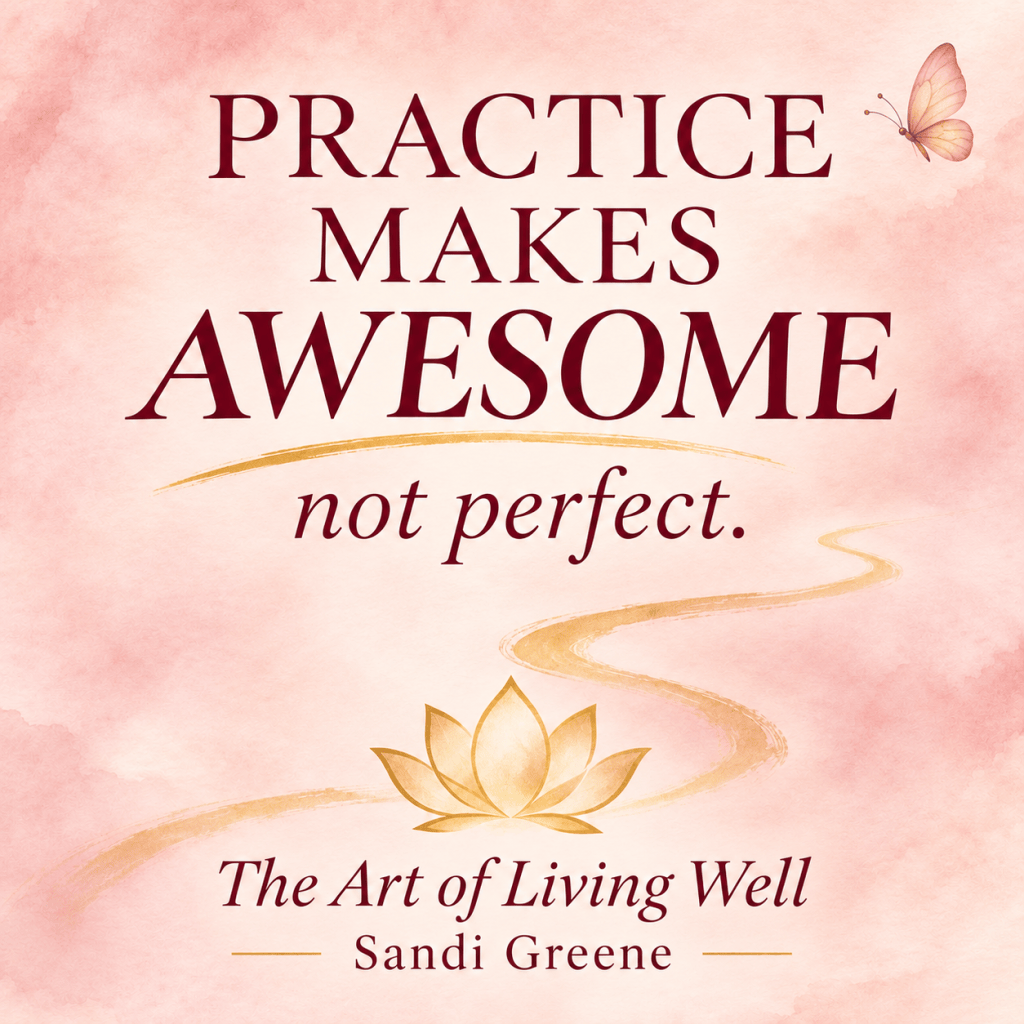
“Practice makes awesome.”
Those three words went straight to my heart, and they have stayed with me ever since.
Perhaps they touched me so deeply because, like many people, I grew up hearing a very different phrase:
Practice makes perfect.
The adults who said it probably meant to encourage us. Keep trying. Work hard. Do your best.
But children sometimes absorb a deeper and more damaging message: If you practice hard enough, you should eventually get everything exactly right.
That is an impossible standard for a child—and a painful one to carry into adulthood.
How Perfectionism Takes Root
Children are natural beginners. They wobble, spill, miss, forget, experiment, and try again. That is how learning happens.
But when praise and approval seem tied to getting something right, mistakes can begin to feel dangerous. We may start believing that making a mistake means there is something wrong with us.
Instead of remaining curious, we become self-conscious. We compare ourselves with others. We hide what we do not know. We hesitate to try anything we might not do well.
The child who once created freely may become the adult who says:
I’m not ready yet.
I need to learn more first.
What if I fail?
What will people think?
The person with a story to tell never begins writing it. The woman who longs to paint, teach, speak, travel, start a business, or create a new chapter keeps waiting until she feels completely prepared.
But confidence rarely arrives before we begin. It grows because we begin.
That is one of perfectionism’s cruelest tricks: it disguises itself as a commitment to excellence while quietly preventing us from fully participating in our own lives.
When Perfect Becomes All or Nothing
Perfectionism creates an all-or-nothing way of thinking.
If I cannot do it perfectly, why begin?
If I miss one day, I have ruined the entire practice.
If my first attempt is awkward, perhaps I’m simply not good at it.
If someone might criticize me, it may be safer not to share my work at all.
So we procrastinate. We overprepare. We revise endlessly. We abandon new practices before they have time to take root—or push ourselves relentlessly while never feeling that anything we do is quite enough.
The cost is not only unfinished projects or missed opportunities. We also lose joy, playfulness, curiosity, creativity, and trust in ourselves.
Perfectionism does not call forth the highest version of who we are. It keeps that version hidden behind fear.
A More Compassionate Way to Grow
“Practice makes awesome” offers us a different path.
It does not mean lowering our standards or no longer caring about the quality of what we create. It means replacing impossible perfection with wholehearted participation.
Awesome does not mean flawless.
Awesome can mean brave.
Alive.
Sincere.
Curious.
Improving.
Willing to begin again.
It leaves room for the shaky first attempt and the messy middle. It honors the courage required to return after disappointment.
Practice says: I am learning.
Practice says: I do not need to know everything before I begin.
Practice says: A mistake is information—not a verdict on my worth.
Practice says: I can pause, adjust, and try again.
The Wisdom of Beginner’s Mind
Buddhist philosophy offers us the beautiful practice of beginner’s mind: meeting our experiences with openness, curiosity, and fewer fixed conclusions.
A beginner does not have to perform mastery. A beginner is allowed to be present, pay attention, and learn.
Mindfulness helps us notice the perfectionist voice without automatically obeying it. We may hear the old messages:
Do it right.
Don’t fail.
Don’t let anyone see you struggle.
And then, rather than judging that frightened part of ourselves, we can respond compassionately:
Thank you for trying to protect me. But I am allowed to learn. I am allowed to be unfinished. I am allowed to let people see me becoming.
That pause creates freedom.
Instead of asking, “Can I do this perfectly?” we can ask:
“What is the next loving, courageous step?”
Practicing Awesome in Everyday Life
We practice awesome when we return to meditation after a distracted morning.
We practice awesome when we move our bodies with respect rather than punishment.
We practice awesome when we write the imperfect first paragraph, have the honest conversation, learn a new skill slowly, or begin again after losing momentum.
We also practice awesome when we change how we speak to children—and to the child still living within us.
Instead of praising only the polished result, we can honor effort, creativity, persistence, kindness, and courage. We can make room for mistakes without shame. We can remind one another that growth is rarely a straight line and that worth is never earned through flawless performance.
Imagine what might change if every child learned:
You do not have to be perfect to be loved.
You do not have to get everything right to belong.
Your mistakes are part of learning and becoming.
And imagine what might change if we finally offered those same words to ourselves.
An Invitation to Begin
What have you been postponing because you cannot yet do it perfectly?
Perhaps today is not the day to master it.
Perhaps today is simply the day to begin.
Take one small step. Let it be clumsy. Let it be incomplete. Let it teach you something.
Then return tomorrow—not because practice makes perfect, but because practice makes us more courageous, capable, compassionate, and fully alive.
I remain deeply grateful to Nancy Levin for my training with her and for this simple teaching that continues to guide me.
Practice makes progress.
Practice makes possibility.
Practice makes awesome.
With love,
Sandi
The Art of Living Well
sandigreene.com

Leave a Reply