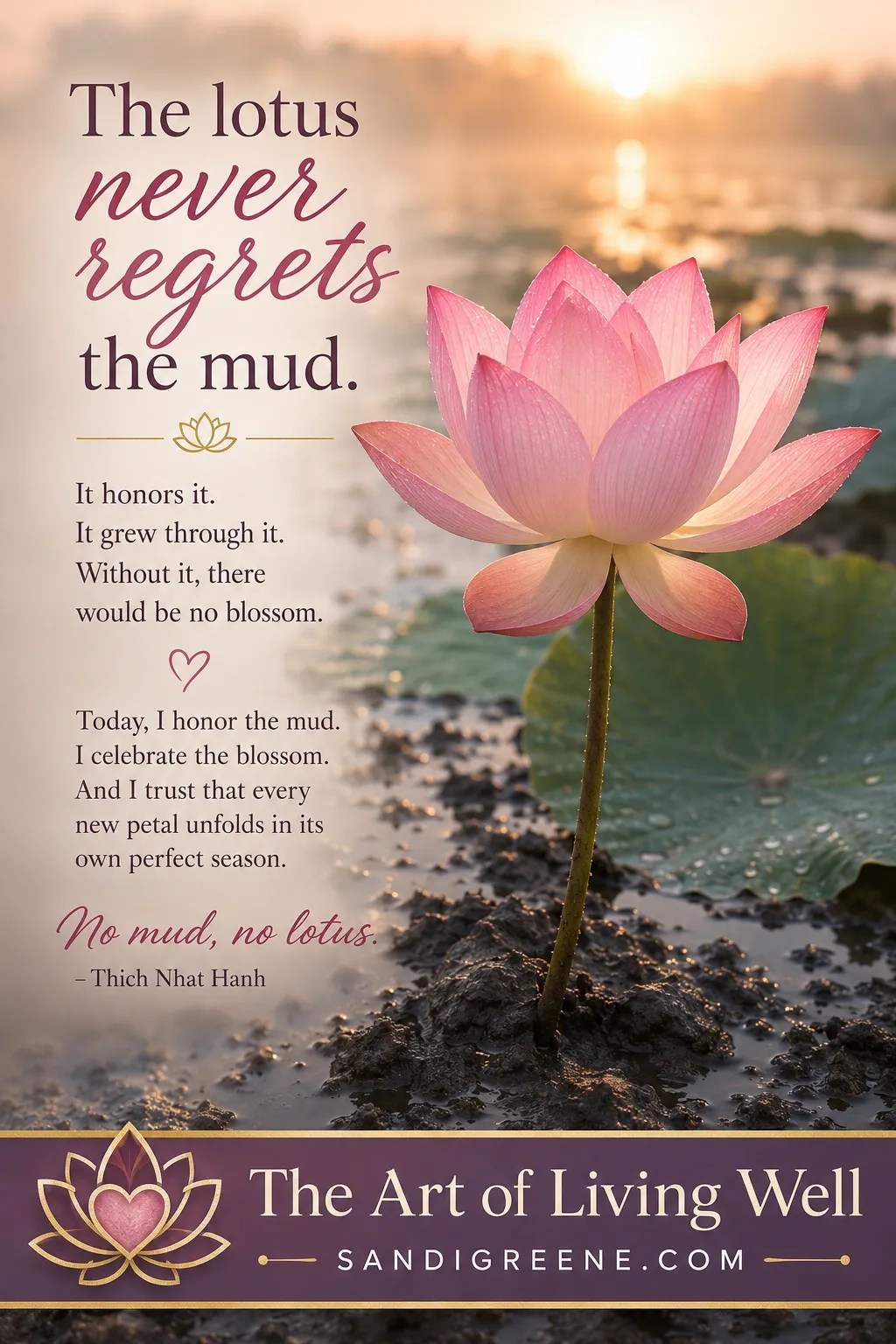
The lotus has become one of my favorite symbols.
It rises from dark, murky water, moving toward the light until eventually it opens into something extraordinarily beautiful.
And yet the lotus never looks back at the mud and says:
I shouldn’t have had to grow there.
The mud was part of the journey.
I find myself thinking about that more and more as I grow older.
There are chapters of my life I would never choose to live again. There have been losses, disappointments, relationships that changed, dreams that didn’t unfold as I expected, and times when I simply couldn’t see the way forward.
But I no longer want to argue with my past.
I want to honor it.
Not because everything that happened was good.
But because all of it belongs to the life that brought me here.
We Are More Than What Happened to Us
Meditation has given me a different relationship with my story.
When I sit quietly and allow thoughts, memories and emotions to arise without becoming attached to them, I begin to recognize something profound:
I have a story.
But I am not my story.
Beneath the roles I’ve played, the things I’ve accomplished, the mistakes I’ve made, the people I’ve loved, the things I’ve lost and all the identities I’ve worn over the years, something essential remains.
The witness.
The awareness that notices it all.
Yoga philosophy has been pointing toward this truth for thousands of years.
And meditation allows us to experience it rather than merely understand it intellectually.
We discover that there is something within us that was never damaged by the mud.
Healing Doesn’t Mean Erasing the Past
The work of the late physician and teacher Dr. David Simon resonates deeply with me because he approached healing as something involving the whole person—body, mind, emotions and spirit.
Healing isn’t pretending something didn’t happen.
And it isn’t endlessly analyzing the past.
Sometimes healing means being willing to look compassionately at what happened, receive whatever wisdom it contains, and loosen our grip on the rest.
We don’t have to carry every chapter into the next one.
This is where mindfulness becomes practical.
We notice what we are still holding.
An old resentment.
A belief about ourselves.
A relationship we’ve outgrown.
A regret.
An expectation about how our lives were supposed to turn out.
And instead of judging ourselves for carrying it, we become curious.
Is this still mine to carry?
Aparigraha: The Grace of Letting Go
One of the principles of yoga philosophy that has become increasingly meaningful to me is aparigraha—non-grasping, non-clinging.
At first, letting go can sound like loss.
I’m beginning to experience it as freedom.
Letting go doesn’t mean that something didn’t matter.
It means I no longer need to hold it tightly in order to honor what it meant.
I can appreciate a chapter without living there.
I can love someone without possessing them.
I can treasure a memory without trying to recreate it.
I can acknowledge regret without allowing it to define me.
And I can desire something beautiful for my future without believing my present life is incomplete without it.
The lotus doesn’t drag the mud with it when it blossoms.
Neither must we.
Healthy Aging Is Also an Inner Journey
We talk a great deal about the physical aspects of healthy aging—nutrition, movement, sleep and caring for our bodies.
All of those matter deeply.
But I believe conscious aging also asks something of the heart.
What are we willing to release?
What still wants to be healed?
What relationships nourish us?
What are we ready to forgive?
What do we want to carry forward?
And perhaps most importantly:
Who are we when we stop defining ourselves by who we used to be?
There is tremendous possibility in that question.
Growing older doesn’t have to mean becoming smaller.
It can mean becoming freer.
More discerning.
More compassionate.
More present.
Less interested in proving ourselves and more interested in living authentically.
The Mud and the Blossom Belong Together
I wouldn’t be who I am today without the difficult chapters.
That doesn’t mean I needed every painful experience or that suffering is somehow required for spiritual growth.
It means something much more empowering:
What happened does not get the final word.
We do.
We can choose what we make of what happened.
We can allow pain to deepen compassion.
We can allow disappointment to clarify what matters.
We can allow endings to create space.
We can allow uncertainty to teach us trust.
And we can continue opening toward the light.
Again and again.
Keep Turning Toward the Light
At this point in my life, I don’t want to spend precious energy regretting the mud.
I want to live.
I want to teach.
I want to meditate.
I want to keep learning.
I want friendships that are genuine and reciprocal.
I want to remain open to love.
I want to nourish my body, mind and spirit.
I want to notice beauty.
And I want to meet whatever comes next with an open heart.
Perhaps this is The Art of Living Well:
Not creating a life untouched by difficulty.
But learning how to remain rooted while continuing to reach toward the light.
The mud is part of my story.
But it is not where I live anymore.
I am here for the blossom.
With love,
Sandi