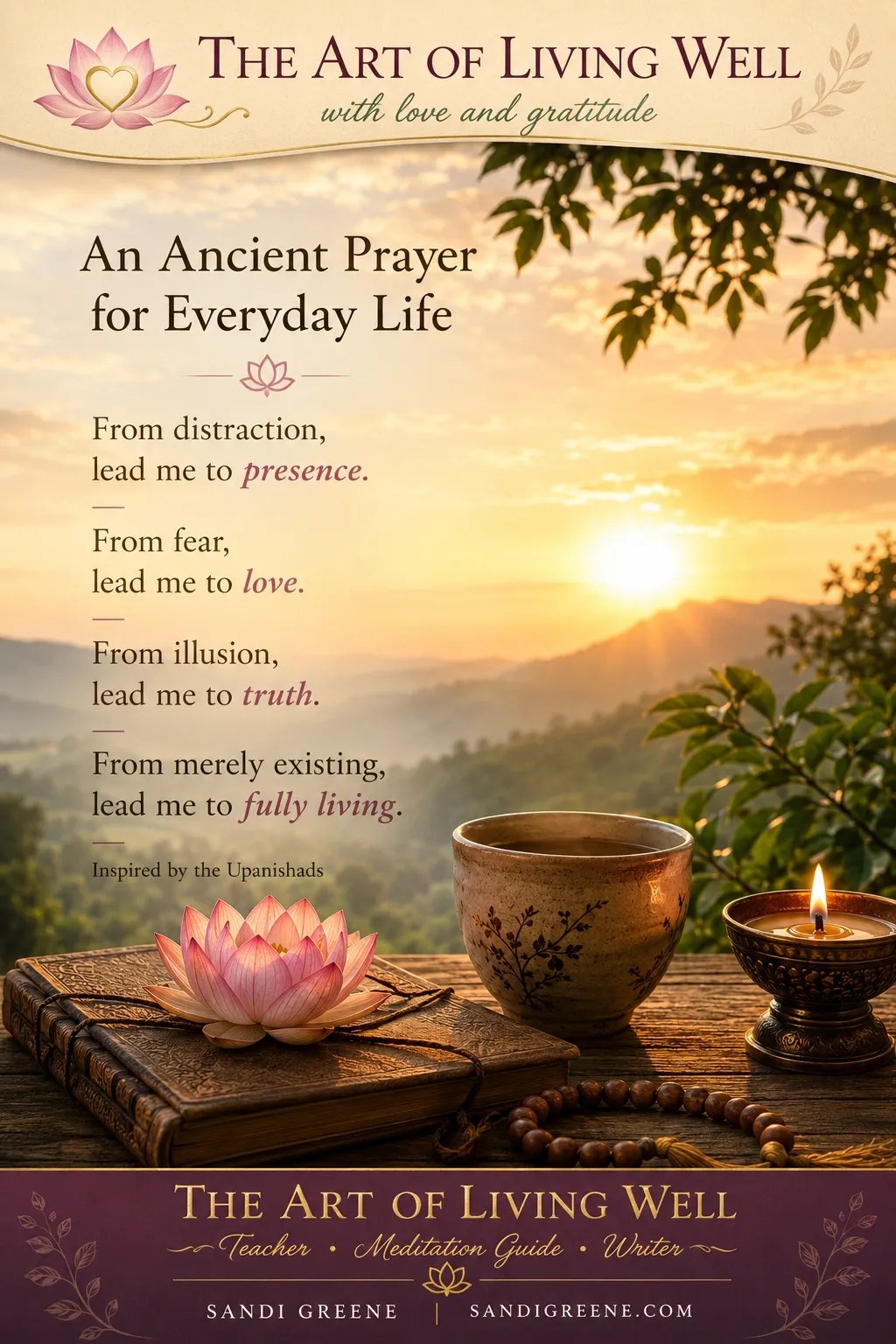
Thousands of years ago, seekers gathered with teachers and asked questions that still live within us today.
Who am I?
What is real?
What brings lasting peace?
What remains when everything around me changes?
These questions lie at the heart of the Upanishads, some of the ancient wisdom texts of India and part of the philosophical foundation of yoga.
What fascinates me is not simply that these teachings have survived for thousands of years.
It is that they still feel so relevant.
At 78, I am not studying ancient wisdom because I want to become a scholar of philosophy.
I am studying it because I want to know how to live.
Nothing Essential Is Missing
One of the teachings that has taken root most deeply in me comes from the ancient Sanskrit invocation Purnamadah.
Its message, as I experience it, is beautifully simple:
Nothing essential is missing.
That idea challenges so much of what our culture teaches us.
We are continually encouraged to become more, accomplish more, acquire more and improve ourselves.
Even spiritual growth can become another project of self-improvement.
But what if our deepest work isn’t becoming someone else?
What if it is remembering who we already are?
Meditation keeps bringing me back to that question.
When the mind becomes quieter—even briefly—I experience something underneath all the striving.
Presence.
Awareness.
Enoughness.
A sense that I do not have to earn my right to be here.
Ancient Wisdom Meets Everyday Life
This is one reason my current meditation teacher training with Davidji has been so meaningful to me.
I am reading widely—from the Upanishads, the Bhagavad Gita and the Yoga Sutras to Buddhist teachings, Ram Dass, Pema Chödrön, Nonviolent Communication and contemporary approaches to meditation and healing.
Yet I keep noticing that the deeper I travel into these teachings, the simpler the message becomes.
Be present.
Listen.
Live consciously.
Release what you cannot control.
Love wholeheartedly.
Return to balance.
And remember who you are beneath all the noise.
Ancient wisdom becomes meaningful to me only when it changes the way I live on an ordinary Tuesday morning.
Body, Mind and Spirit
This is also why I resonate so strongly with the work of the late physician and neurologist Dr. David Simon.
His integration of Western medicine with Ayurveda, meditation, yoga philosophy and mind-body healing reflects the wholeness I am seeking in my own life.
We aren’t merely bodies to be repaired.
We aren’t minds that need to be controlled.
And we aren’t spirits floating somewhere above the practical realities of human life.
We are whole beings.
Body. Mind. Spirit.
Ayurveda asks me to listen to the rhythms of my body and the natural world.
Meditation teaches me to listen inwardly.
Yoga philosophy asks me to bring what I discover into the way I actually live.
For me, this is becoming the foundation of healthy aging and conscious living.
Not more rules.
More awareness.
The Freedom of Non-Attachment
Another teaching that has become central to my life is aparigraha, the yogic principle of non-grasping or non-attachment.
And the Bhagavad Gita gives us a companion teaching: we can choose our actions, but we cannot control their fruits.
This has become extraordinarily practical for me.
I can show up wholeheartedly without trying to control what happens next.
I can teach without needing to know where the teaching will lead.
I can write without knowing who will read the words.
I can nurture friendships without forcing connection.
I can remain open to meaningful opportunities.
I can open my heart to love without chasing it.
I can desire a beloved without treating my present life as a waiting room.
Wholeness comes first.
From that place, relationship becomes something we share—not something another person must provide.
Growing Older, Growing Inward
There is tremendous emphasis in our culture on staying young.
I’m interested in something different.
I want to grow whole.
Healthy aging, for me, includes caring deeply for this physical body. But it also means remaining curious, emotionally alive, spiritually awake and open to new relationships, new ideas and new possibilities.
It means continuing to learn.
Continuing to love.
Continuing to release identities I’ve outgrown.
Continuing to discover what is true.
Perhaps one of the great privileges of growing older is that we finally have enough lived experience to recognize what doesn’t matter.
And enough wisdom to devote ourselves to what does.
Coming Home
The ancient sages of the Upanishads were asking questions about the nature of the self thousands of years before any of us arrived here.
And still we ask them.
Who am I beneath my roles?
What is enough?
What is mine to do?
What can I release?
How do I live with an open heart in a world I cannot control?
I don’t expect to arrive at a final answer.
Perhaps that’s not the point.
Perhaps The Art of Living Well is learning to inhabit the questions with greater presence.
To listen.
To notice.
To participate fully.
To love what is here.
And to trust that I don’t need to become something more before I am worthy of this life.
The older I become, the more I understand:
The journey isn’t taking me somewhere else.
It is bringing me home.
Nothing essential is missing.
With love,
Sandi