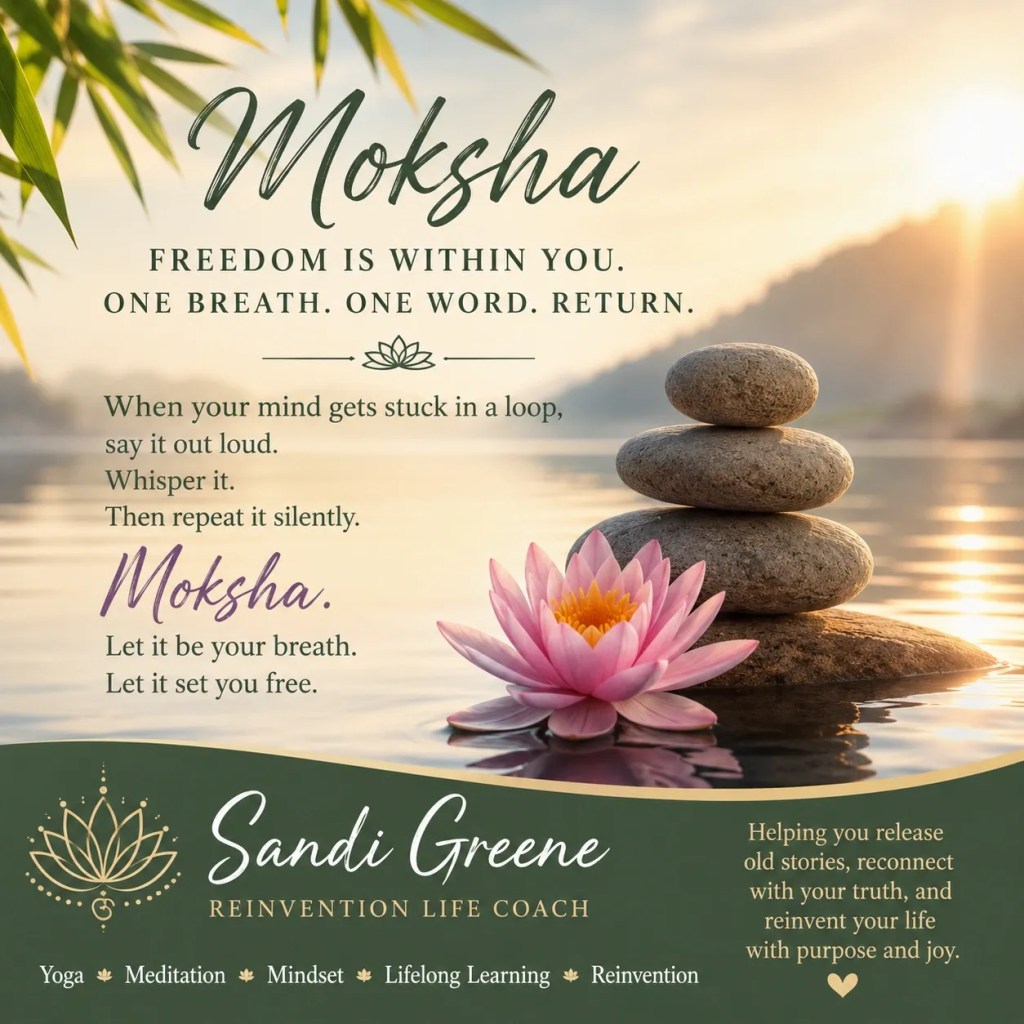
There are certain words that seem to arrive at exactly the right moment.
Moksha is one of them.
In yoga philosophy, moksha points toward liberation—freedom from the patterns, attachments, and conditioning that keep us caught in suffering.
That can sound like a lofty spiritual idea.
But lately I’ve been thinking about moksha in a much simpler way:
What if freedom is available in an ordinary moment?
Not someday. Not after I have figured everything out. Not when everyone around me behaves the way I would like them to.
Right here.
One breath. One pause. One conscious choice.
Freedom From the Loop
We all know the experience.
Something happens and the mind begins circling around it.
We replay the conversation.
We imagine what we should have said.
We predict what might happen next.
We construct entire futures from something that happened five minutes ago.
And suddenly we are no longer living in the present moment. We are living inside the story our mind has created about it.
Meditation has taught me that I don’t have to stop thoughts from arising.
I simply don’t have to follow every one of them.
That distinction has become enormously freeing.
The Witness Within
One of the teachings I continue to encounter through meditation, the Upanishads, the Bhagavad Gita, and yoga philosophy is the idea of the witness—the awareness that can observe our thoughts without becoming completely identified with them.
I can notice:
There is worry.
There is irritation.
There is fear.
There is longing.
But those experiences are moving through me.
They are not the whole of me.
The moment I can witness what is happening, rather than automatically becoming it, something opens.
There is space.
And within that space is choice.
Aparigraha: Loosening the Grip
Moksha also brings me back to aparigraha, the yogic practice of non-grasping or nonattachment.
I am discovering how much energy can be spent trying to hold life still.
Wanting certainty.
Wanting a particular outcome.
Wanting someone else to understand.
Wanting the future to unfold according to the picture in my mind.
But life keeps reminding me that my responsibility is not to control every outcome.
The Bhagavad Gita teaches us to give ourselves wholeheartedly to our actions while releasing our attachment to the fruits of those actions.
Show up. Do what is mine to do. Then loosen my grip.
There is tremendous freedom in that.
Moksha in Everyday Life
Perhaps moksha isn’t only some distant state of enlightenment.
Perhaps we practice liberation every time we interrupt an old pattern.
Every time we choose a breath instead of an immediate reaction.
Every time we release a story that no longer serves us.
Every time we stop chasing what is not ours to chase.
Every time we say no when no is true—or yes when yes is true.
Every time we allow another person to be who they are without abandoning who we are.
This is where meditation and mindfulness become part of everyday life.
Freedom becomes something we practice.
Freedom and Healthy Aging
At 78, freedom means something different to me than it once did.
I am less interested in accumulating and increasingly interested in releasing.
Old identities.
Old expectations.
Old stories about who I should be.
Even the idea that aging means becoming less.
Healthy aging, for me, is increasingly about becoming more present, more curious, more discerning, more alive—and more free to be myself.
Ayurveda teaches me to listen to the rhythms of my body.
Yoga teaches me to live in alignment.
Meditation teaches me to return to the stillness beneath the noise.
And life itself keeps teaching me when to hold on and when to let go.
One Breath. Return.
Sometimes freedom really can begin that simply.
When my mind becomes caught in a loop, I can notice it.
Pause.
Breathe.
Return.
I don’t have to solve my entire life in that moment.
I only have to come back to the moment I am actually living.
Perhaps that is one small taste of moksha:
The freedom to stop struggling with what is, return to ourselves, and meet life from a place of presence rather than fear.
Nothing essential is missing.
Freedom may be much closer than we think.
With love,
Sandi