One of the things I love about studying different wisdom traditions is discovering how often they point toward the same essential truths.
Live consciously.
Keep learning.
Practice what you believe.
And don’t try to do it all alone.
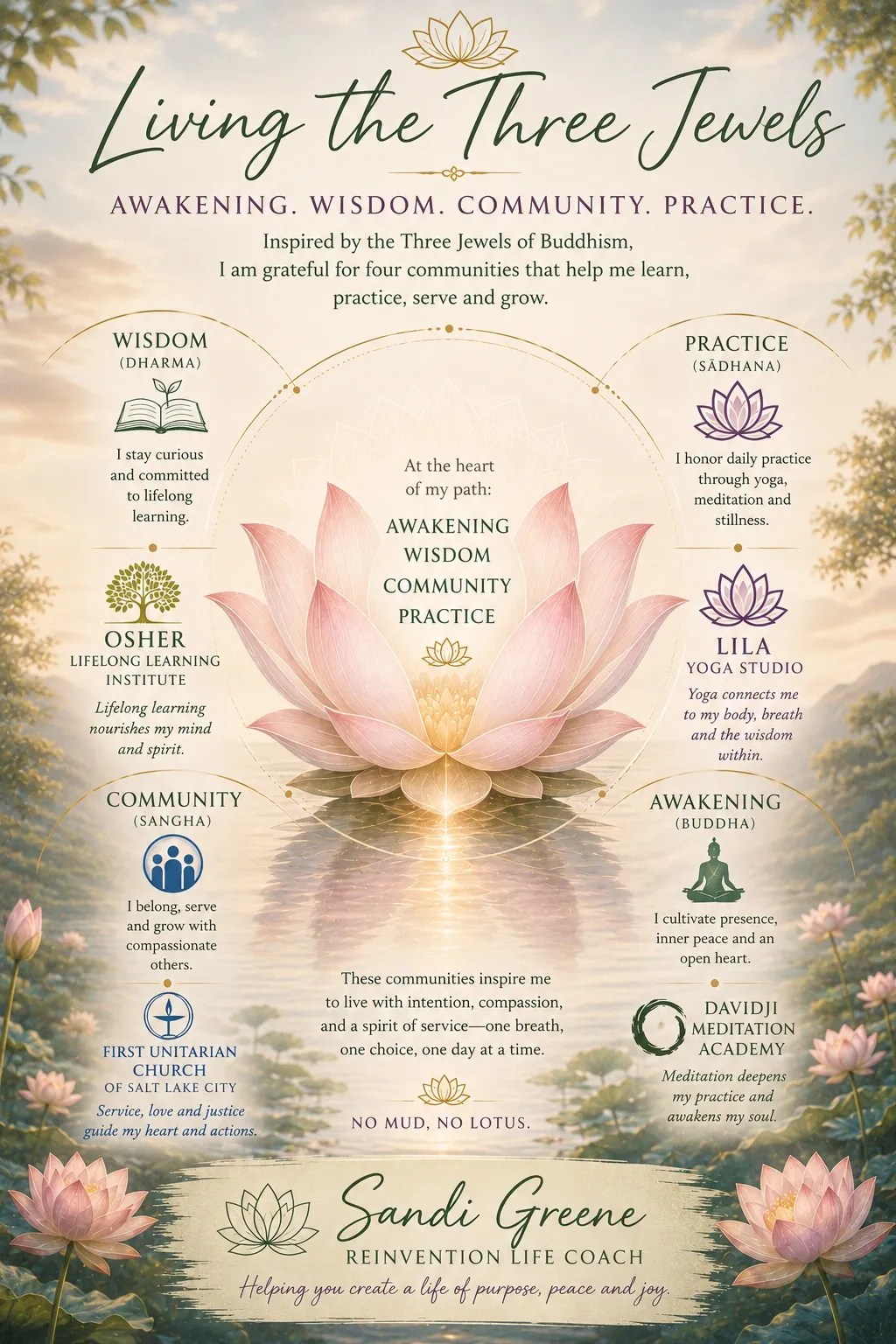
In Buddhism, the Three Jewels traditionally refer to the Buddha, the Dharma, and the Sangha—the awakened teacher, the teachings, and the community of practitioners.
As I’ve reflected on these ideas, I’ve begun to see how beautifully they show up in my own life.
Not as abstract philosophy, but as something I am actually living.
Awakening: Remembering Who We Are
For me, awakening does not mean reaching some extraordinary spiritual state.
It means becoming more awake to the life that is already here.
Meditation has become one of my most important practices for doing that.
I sit. I breathe. I notice.
Thoughts come and go. Feelings arise. The mind wanders.
And then I return.
Again and again, meditation reminds me that beneath all the activity of the mind there is an awareness that is simply present.
Nothing essential is missing.
Sometimes we simply become quiet enough to remember.
Wisdom: Remaining a Student
At 78, I am still very much a student.
Perhaps more than ever.
My meditation teacher training with Davidji has led me deeper into meditation, mindfulness, yoga philosophy, Ayurveda, the Upanishads, the Bhagavad Gita, Buddhist teachings, and the wisdom of teachers whose work continues to shape the way I live.
But I am discovering that wisdom is not measured by how many books we have read.
Wisdom begins when the teachings enter our lives.
How do I respond when I am triggered?
Can I listen when my body tells me something?
Can I remain curious instead of certain?
Can I release an outcome rather than trying to control it?
Can I bring compassion into an ordinary conversation?
That is where philosophy becomes practice.
Practice: Living What We Know
The Sanskrit word sadhana refers to spiritual practice.
I love that because it reminds me that transformation happens through what we practice repeatedly.
Meditation.
Yoga.
Mindful movement.
Ayurvedic self-care.
Reflection.
Compassion.
Gratitude.
The pause before responding.
None of these practices requires perfection.
They simply ask us to return.
The Art of Living Well is not something I master. It is something I practice.
Community: We Don’t Grow Alone
And then there is community.
The Buddhist concept of Sangha has become especially meaningful to me because I can see how many communities are part of my life now.
Through Osher Lifelong Learning at the University of Utah, I have the privilege of teaching and learning alongside people who remain curious about life.
Through First Unitarian Church of Salt Lake City, I experience service, reflection, relationship, and belonging.
Through my meditation teacher training, I am surrounded by fellow students who are exploring many of the same questions I am.
And through yoga and other communities of practice, I continue to discover how much we learn simply by walking beside one another.
Community doesn’t require us to think alike.
It asks us to show up.
To listen.
To contribute.
To allow ourselves to be changed by one another.
The Three Jewels in Everyday Life
The older I become, the less interested I am in collecting spiritual ideas and the more interested I am in embodying them.
Awaken.
Learn.
Practice.
Connect.
And then begin again tomorrow.
Perhaps healthy aging is partly this: continuing to remain awake, curious, connected, and willing to grow.
We don’t graduate from being human.
We keep learning how to live.
And perhaps that is one of the great privileges of growing older—the opportunity to take everything life has taught us and begin living it more consciously.
Wisdom becomes meaningful when we embody it. Practice becomes sustainable when we return to it. And the journey becomes richer when we share it with others.
With love,
Sandi