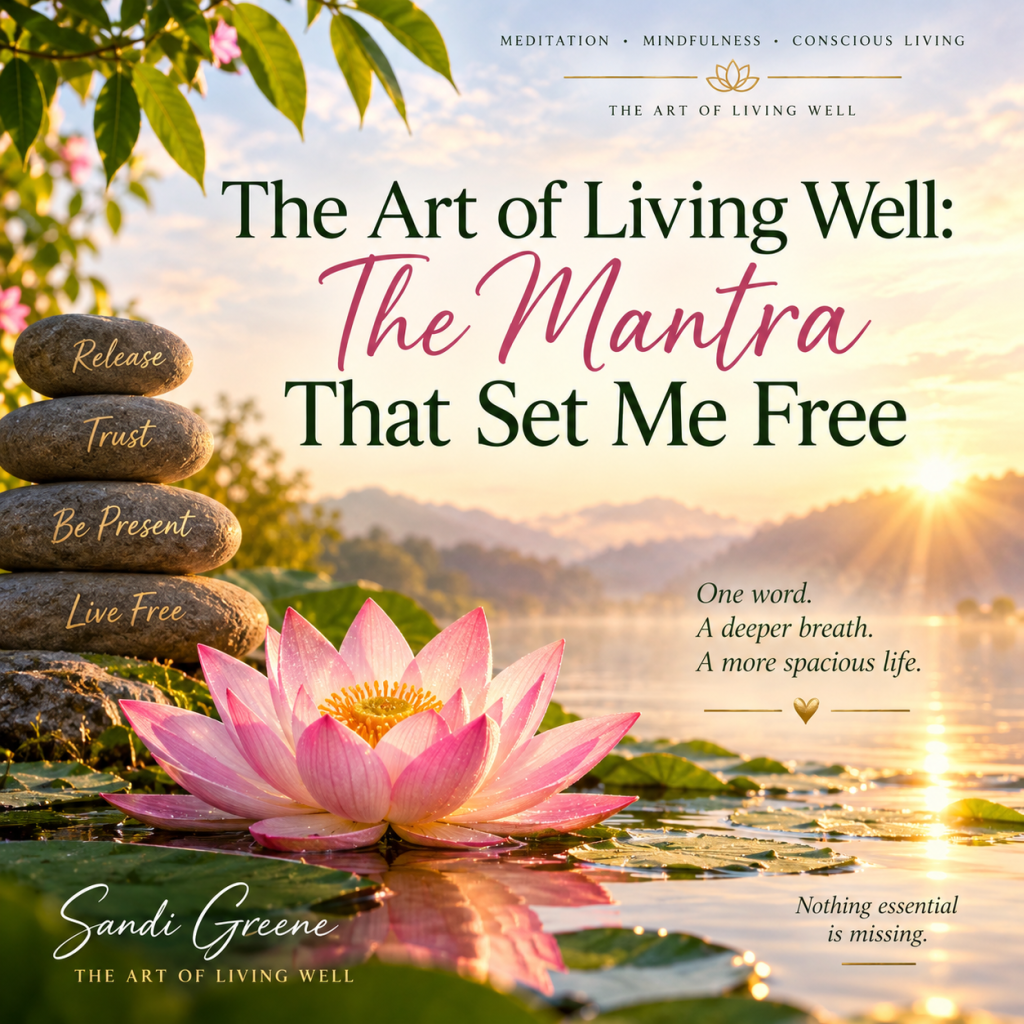
Sometimes a single word arrives at exactly the right moment.
For me, that word was Moksha.
In yoga philosophy, Moksha is often translated as liberation or freedom. It is one of those Sanskrit words whose meaning is much larger than any single English translation.
When I first began working with it, I experienced it very simply.
My mind would become caught in a familiar loop—replaying a conversation, trying to solve something that could not be solved in that moment, worrying about an outcome, or holding tightly to a story.
And I would say:
Moksha.
Sometimes aloud.
Sometimes in a whisper.
Eventually, silently.
One word became a reminder:
I can release this.
Freedom Doesn’t Mean Escaping Life
I once thought freedom meant changing the circumstances.
Fix the problem.
Resolve the relationship.
Know the answer.
Make the right decision.
Get to the other side.
But meditation and yoga philosophy have been teaching me something very different.
Freedom can happen before anything outside of me changes.
I can notice the thought without following it.
I can feel an emotion without becoming consumed by it.
I can want something without grasping for it.
I can take an action without demanding a particular result.
That is a very different kind of freedom.
The Freedom of Nonattachment
One of the teachings that has become increasingly meaningful to me is aparigraha, the yogic principle of non-grasping or nonattachment.
The Bhagavad Gita expresses a similar wisdom: we are responsible for our actions, but we cannot control all the fruits of those actions.
That teaching has become deeply practical for me.
I can show up wholeheartedly.
I can teach what I love.
I can write.
I can nurture friendships.
I can remain open to love.
I can care for my body.
I can continue learning and growing.
And then I can release my demand that life unfold according to my timetable.
My responsibility is how I show up. The outcome is not entirely mine to control.
That feels like Moksha.
Meditation Creates Space
Meditation has given me a place to practice this freedom every day.
Thoughts arise.
Plans arise.
Memories arise.
Desires arise.
And rather than trying to eliminate them, I am learning to witness them.
There is the thought.
There is the feeling.
There is the story.
And there is also the awareness noticing all of it.
That small space changes everything.
It gives me a choice.
I don’t have to follow every thought simply because my mind produces it.
Freedom From Who I Thought I Had to Be
Perhaps one of the greatest freedoms of this season of my life is releasing old identities.
I don’t need to continually reinvent myself.
I don’t need to become a better version of Sandi Greene.
I am much more interested now in becoming fully present to the woman who is already here.
Teacher.
Meditation guide.
Writer.
Student.
Woman still growing, still curious, still discovering what it means to live well.
At 78, freedom isn’t about having life completely figured out.
It is about needing less and less for life to be different before I can be at peace.
One Breath. One Word. Return.
And so Moksha remains with me.
Not as a magic word.
Not as a way of bypassing difficult feelings.
But as a reminder.
When the mind tightens:
Moksha.
When I catch myself grasping for an outcome:
Moksha.
When an old story tries to become my identity again:
Moksha.
Breathe.
Release.
Return.
Perhaps liberation isn’t somewhere we finally arrive.
Perhaps we practice it in small moments—every time we loosen our grip and return to the life that is here.
Nothing essential is missing.
With love,
Sandi